
The Frieze of the Divinity and the Mystic Seal of Academicus
The Strange Triangles of Stone upon the Cover
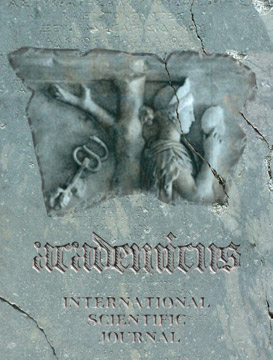
Upon the cover of Academicus International Scientific Journal, there rests a stone. It is not a drawing. It is not an ornament. It is the surviving ghost of a fragment that no longer inhabits this physical world.
When Arta Musaraj wrote to the Directorate of Excavations at Hadrian’s Villa in Tivoli, seeking to question the memory of that small second-century marble relief, cataloged decades earlier in Roberto Vighi’s historic guide under a name that sounds like a prayer, "Frieze of the Divinity," and already chosen by her as the cover of Academicus, the reply returning from Rome carried the sacred paradox of things destined to outlive matter: the piece is no longer physically in the storerooms. It vanished.
Wrested from the silent shadows of the Tiburtine Mouseia, dissolved into the folds of time. Yet, by one of those invisible geometries that only the history of thought knows how to draw, that fragment carved by Neo-Attic hands between 118 and 138 AD had never truly disappeared. Arta Musaraj had already rescued it from oblivion. She had lifted it from the dusty pages of Vighi’s guide and engraved it forever onto the cover of Academicus, turning the journal itself into the one living sanctuary on earth where that marble still speaks.
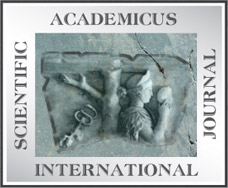
Look closely at that fragment, which today breathes solely within the realm of thought and the written word. It measured barely thirty-five or forty-five centimeters wide by twenty-five or thirty-five high. Yet within those few centimeters of white marble, a flawless triangulation unfolds, to be read from right to left like a liturgy of knowledge:
The Divine Presence (on the right): Minerva (Sophia and Logos). Sculpted in strict profile facing left, severed at the waist by the ancient fracture of the stone, emerges the goddess of wisdom. Two millennia of wind and time had softened the contours of her face, yet could not erase the emblems of her intellectual sovereignty: the Attic-Corinthian helmet with its raised visor, the fringed aegis draped across her breast over the delicate folds of the chiton, and her right arm bent sharply upward. In her lifted hand she cradles an ovoid form: the sacred owl, rounded by the breath of centuries, or perhaps a ritual fruit, the lucid gaze that knows how to decipher the darkness of the unknown.
The Caesura of the Tree (at the center): The Arbor Scientiae. Directly along the median axis of the slab rises a vertical trunk from which two bare branches reach obliquely outward. Within the syntax of the Hadrianic idyllic-sacral landscape, that tree was the threshold transforming architecture into a sacred grove: roots anchored in the hard soil of history, branches stretching toward what humanity has not yet dared to think.
The Enigma of the Key (on the left): Methodos, Initiation, and the Invisible Triangle. Leaning diagonally beside the trunk is a Laconian-Roman key. Time’s fracture severed the deity who once held it, leaving only the instrument suspended in stone, which forms an invisible triangle between life, death, and passages. Its vertices are marked by Janus (lord of doors), Hecate (guardian of dark crossroads), and Proserpina (queen of the underworld), uniting their domains into a single threshold bridging the visible world and the mystery beyond.
Yet where did this relief breathe when Tivoli was the navel of the world?
Not upon an outer wall turned away from the countryside. It stood upon the inner face of the peristyle of the Academy, turned toward the open light of the central garden.
Picture the scene. A vast rectangular courtyard, seventy to seventy-five meters long and forty-five to fifty wide, traced by orthogonal walkways, herms of philosophers, and statues of the Muses: the sanctuary Emperor Hadrian built in the likeness of Plato’s Academy in Athens, a place consecrated to unbound dialogue between the sciences and the arts. All around it ran a covered colonnaded gallery, nearly five meters wide, borne aloft by marble columns rising six meters high. Above the capitals rested the load-bearing architrave; above the architrave, exactly six meters above the earth, ran the frieze of Minerva; and higher still projected the cornice sheltering the relief from the rain beneath a pitched timber roof closed within by painted coffers.
Whoever strolled along the garden paths of the Academy and lifted their eyes saw the sunlight strike the white marble at a slant. And upon the cover of Academicus, the ancient fracture of the stone performed a semiotic miracle: what in Hadrian’s edifice had belonged to two adjacent sequences, the key of Janus on the left and Minerva on the right, fused into a single living allegory. The goddess of wisdom, the tree of memory, and the key of openness (Open Access) that shatters the ivory towers of enclosed knowledge.
Mere coincidence? A provocation of destiny?
No. Whoever knows the sea that divides Vlorë from Italy knows that certain lines are drawn before human beings ever learn to write. In the third book of the Aeneid, Aeneas sets sail from Butrint and the shores of Epirus, beneath the very mountains watching over Vlorë, and first touches Italian soil at Castro, Castrum Minervae, where the temple of Minerva kept vigil upon the headland, before ascending toward Latium and Tivoli. Carrying the image of that fragment from Tivoli back to Vlorë meant completing the reverse voyage of the myth: transforming the Strait of Otranto not into a border, but into a spiritual bridge where Greece, Illyria, and Rome question one another anew.
And then, one final triangle. This time in Rome, within the halls of Sapienza University.
There, inside the historic Doctoral School of Sociology founded by Franco Ferrarotti, giant of sociology and master of science understood as critical conscience and listening to the human, and guided first by Maria Immacolata Macioti and later by Guglielmo Chiodi, Arta Musaraj was called to teach, carrying a luminous voice from the heart of Albania into the Roman academy. Out of that human and intellectual dialogue, a new creature of thought came to life in Rome, the Nuova Accademia, itself a Platonic one, conceived between the very banks where the Aeneidian Tiber flows through the Eternal City and the Adriatic shores of Vlorë once furrowed by the hero's sails, as a space free from dogma where sociology, economics, history, and philosophy sat at the very same table.
They left the cracks untouched upon that cover. The diagonal fracture cutting through the marble behind Minerva’s helmet was never erased. Why? Because what is lost to the earth can never be wrested from the spirit. True science is never a smooth, closed, or finished monument: it is a living fragment, a luminous trace torn from the silence of time, awaiting each new generation with its own key, offering it freely, without barriers or price, to anyone who seeks the light of understanding.