

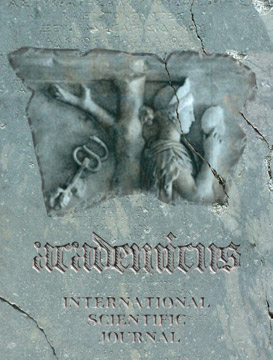
Frieze of the Divinity and the Mystic Seal of Academicus
The Strange Triangles of Stone upon the Cover
Upon the cover of Academicus International Scientific Journal, there rests a stone. It is not a drawing. It is not an ornament. It is the surviving ghost of a fragment that no longer inhabits this physical world.
When Arta Musaraj wrote to the Directorate of Excavations at Hadrian’s Villa in Tivoli, seeking to question the memory of that small second-century marble relief, cataloged decades earlier in Roberto Vighi’s historic guide under a name that sounds like a prayer, "Frieze of the Divinity," and already chosen by her as the cover of Academicus, the reply returning from Rome carried the sacred paradox of things destined to outlive matter: the piece is no longer physically in the storerooms. It was stolen, vanished.
Wrested from the silent shadows of the Tiburtine Mousela, dissolved into the folds of time. Yet, by one of those invisible geometries that only the history of thought knows how to draw, that fragment carved by Neo-Attic hands between 118 and 138 AD had never truly disappeared. Arta Musaraj had already rescued it from oblivion. She had lifted it from the dusty pages of Vighi’s guide and engraved it forever onto the cover of Academicus, turning the journal itself into the one living sanctuary on earth where that marble still speaks.